How to Track UTM Parameters in Webflow Forms
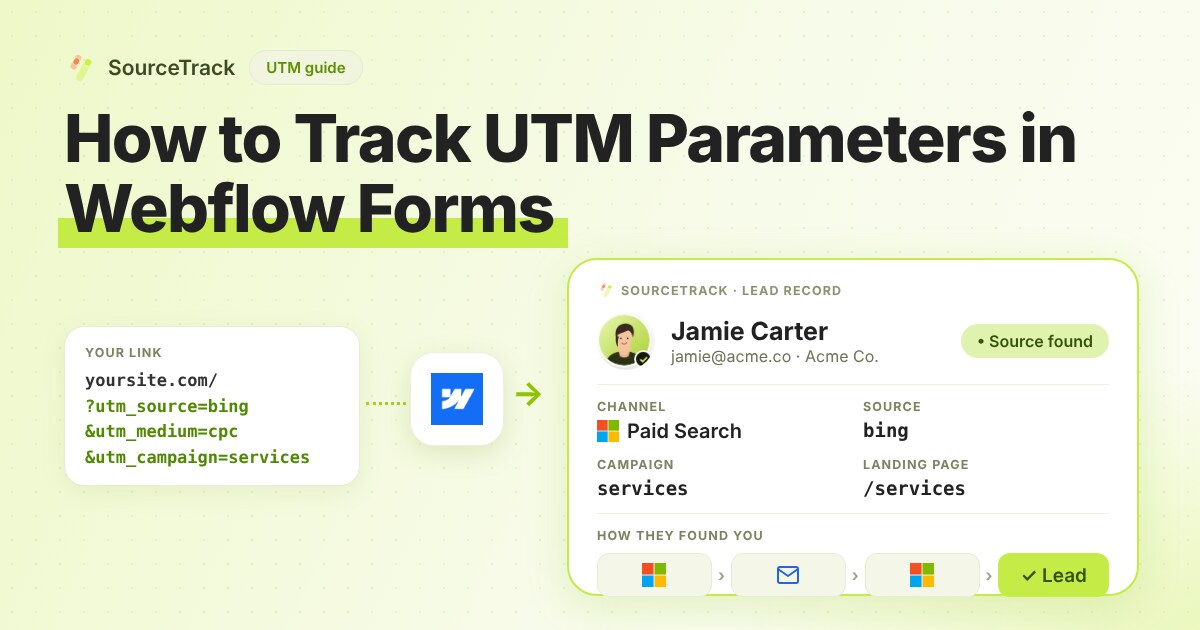
See which campaign sent each Webflow form lead. Add one script tag in Site settings, no hidden fields, then test with a UTM link.
- Author
- SourceTrack Team
- Category
- Track UTM Parameters
- Read Time
- 05 Mins read
- Published Date
Inside the page
- How Webflow handles UTM parameters on its own
- What SourceTrack records for each Webflow form lead
- Step 1: Add the script tag
- Step 2: Put your Webflow form on a page
- Step 3: Open a test link with UTMs
- Step 4: Look at the lead in SourceTrack
- What you will see
- Common problems and fixes
- Further reading
- Frequently asked questions
- Do I need hidden fields in Webflow forms?
- Do I need to publish the site after adding the script?
- Will every form on my site count as a lead?
- What if a visitor comes without a UTM link?
- Why did my Webflow test lead not show up?
- Next step
You built a landing page in Webflow, you send traffic to it from several places, and form entries arrive in your inbox. Which ad, email or post sent each one? This guide shows how to answer that. You add one script tag in your site settings, and SourceTrack links each Webflow form lead to the campaign that sent the visitor.
How Webflow handles UTM parameters on its own
Webflow does not capture UTM parameters from the link into your form entries by itself. A standard Webflow form saves the fields you put in it. To save campaign tags you would add hidden inputs and then fill them with your own code, which reads the tags from the page address. The details of that are outside what Webflow documents for forms, so check the vendor documentation if you plan to build it.
What Webflow does document is where such code goes. According to Webflow’s help center, you open Site settings and choose the Custom code tab. Head code applies to the whole site and is placed before the closing head tag. Custom code needs a Core, Growth, Agency or Freelancer Workspace, or an active Site plan. Webflow also says only HTML, CSS and JavaScript are allowed, that external scripts in the head can slow a page unless they use async or defer, and that its support team cannot troubleshoot your custom code.
A hand-built hidden field approach has the usual limits:
- The tags must be in the address. If a visitor reads another page before the form page, the tags are no longer in the address, and the hidden fields stay empty.
- One page view. A hidden field holds one value from one load. It cannot tell you both where the visitor first came from and what brought them back.
- Code you must keep working. When you redesign the form or add a new one, the code has to follow.
- The result sits in form entries. You see tags next to the entry, but not next to the pages the visitor read.
What SourceTrack records for each Webflow form lead
A Webflow form is rendered in your own page, so it is on the same site as the script. The tracker sees the form being sent and links the lead to the visit that brought the visitor. For each lead you can see:
- UTM parameters:
utm_source,utm_medium,utm_campaign,utm_contentandutm_term. - Ad click IDs:
gclidfor Google Ads,fbclidfor Meta Ads,msclkidfor Bing Ads,li_fat_idfor LinkedIn Ads andttclidfor TikTok Ads. - Referrer and landing page: the site that sent the visitor and the first page they viewed.
- First touch and last touch: both appear in the lead’s touchpoint timeline, so you can compare what started the journey with what closed it.
All of this comes from the visit, not from the form, so you do not add hidden fields. The tracker is first-party, sets no third-party cookies, honours Do Not Track and Global Privacy Control, and Cookieless Mode is a setting on every plan.
Step 1: Add the script tag
Copy your one script tag from SourceTrack. In Webflow, open Site settings, choose the Custom code tab and paste the tag into the head code section. Save, then publish the site. Custom code does not run in the Designer canvas, so you only see it on the published site. The install guide shows what the tag looks like and the checks to run.
Step 2: Put your Webflow form on a page
Use a normal Webflow form on a page of your site. A form counts as a lead when its name or address, or the address of the page, includes a word such as contact, demo or quote. So a form on /contact counts, and one named “Search” does not. Do not add hidden fields.
Step 3: Open a test link with UTMs
Open your published page with UTMs on the end of the link, like this:
https://yourwebsite.com/contact?utm_source=test&utm_medium=email&utm_campaign=form_test
Open it in a new private window. If your browser sends Do Not Track or Global Privacy Control, SourceTrack respects that and will not track the visit. Fill in the form with a test email and send it.
Step 4: Look at the lead in SourceTrack
Open SourceTrack and find the new lead. Check that the source, medium and campaign match your test link.
What you will see
Your test lead shows the source test, the medium email and the campaign form_test, along with the page the visitor landed on. If you see these, the form is being tracked.
Common problems and fixes
- Nothing shows up at all. Check that you published after saving the code. View the page source of the live page and look for the tag inside the head. Then open your browser’s developer tools, choose Network, filter by
trackand reload. A successful request means the script is running. - Do Not Track or Global Privacy Control is on. SourceTrack respects both. If your browser or an extension sends either signal, the tracker does not run, and your test visit will not appear. Test in a browser without them.
- The tag is in the wrong place. If you pasted it into a single page’s code instead of the site-wide head code, other pages carry no script. Webflow lets you add code per page, so check which section you used.
- The form is a third-party embed. A form from another tool, placed in an iframe, submits in its own frame. The page script cannot see that. Use the guide for that tool instead.
- The test looks wrong. Open your tagged link in a new private window and open it directly, rather than clicking through from another page on your site.
- Everything shows as Direct. The visit had no tags and no referring site. Tag the links you control. The troubleshooting guide explains why a visit can arrive without a referrer.
Further reading
- Webflow University: Site-level code: where to add site-wide custom code in Site settings.
- Google Analytics Help: URL builders, collect campaign data with custom URLs: how UTM parameters are added to destination URLs so Analytics can attribute traffic to campaigns.
- How to track UTM parameters in Elementor forms: the same set-up for Elementor.
- How to track UTM parameters in Contact Form 7: the same set-up for a WordPress form plugin.
Frequently asked questions
Do I need hidden fields in Webflow forms?
No. Once the script is on your site, SourceTrack captures Webflow forms that sit on your page. You do not change the form.
Do I need to publish the site after adding the script?
Yes. Custom code in Site settings only takes effect on the live site after you publish it. Test on the published address, not in the Designer.
Will every form on my site count as a lead?
No. A form counts as a lead when its name or web address, or the page address, has words like contact, demo or quote. Forms that look like login, password, reset or search forms do not count.
What if a visitor comes without a UTM link?
SourceTrack still looks at where they came from, such as a search engine or another website. If the link has no tags and the visit has no referring site, it shows as Direct. So tag the links you control, like emails, ads and social posts.
Why did my Webflow test lead not show up?
First, check that you published the site after adding the script. Second, try a private window that does not send Do Not Track or Global Privacy Control, because SourceTrack respects both. Then see the troubleshooting guide.
Next step
Tag the links you share, then watch the leads come in. Learn the basics in how to track UTM parameters, check your links with the UTM validator, read the install guide or the troubleshooting guide, or see how every tool connects. If you also use other form tools, the Tally guide and the Gravity Forms guide work the same way.
Related Blogs
How to Track UTM Parameters: The Basics
Learn what UTM parameters are, how to build tagged links, and how to see which campaign sent each lead. Plain steps, no code.
SourceTrack Team
Attribution & Growth Engineering
20 Oct, 2026
How to Track UTM Parameters in Cal.com
See which campaign sent each Cal.com booking. Add one script tag to the page with your embed, then test with a UTM link.
SourceTrack Team
Attribution & Growth Engineering
20 Oct, 2026
How to Track UTM Parameters in Calendly
See which campaign sent each Calendly booking. Add one script tag to the page with your embed, then test with a UTM link.
SourceTrack Team
Attribution & Growth Engineering
20 Oct, 2026